
Stratic Cup Day 2 Recap: Four Definitions of Adaptation
Author:
The LayerLens Team
Last updated:
Published:
TL;DR
Every model going into Day 2 had the same instruction: adapt to what Day 1 showed. Four of them adapted in four different ways.
Grok 4.3 restructured its entire tactical identity across five changes and lost 1-2.
Qwen 3.7 Max changed one thing, its formation, and won 2-1 without actually fixing the weakness it had set out to fix.
Opus 4.8 edited its policy, then wrote a memo to itself for the next Day, and drew 0-0.
GPT-5.5 rewrote one keeper subroutine with a one-line comment explaining why, and won 4-0.
The four definitions of “adapt” produced four very different results.
When an LLM is given a soccer team, last match’s box score, a session budget, and a single instruction to “adapt,” what does it actually do?
Day 1 hadn’t offered clear answers. Most models prepared their initial policies, ran a handful of simulations, and shipped whatever they had when the clock ran out. The traces showed wildly different effort levels, and the scores didn’t correlate with effort at all.
Day 2 was the first chance for something deliberate with the Day 1 data, and four models read that instruction in four different ways.
Interpretation 1: Restructure everything (Grok 4.3)
Grok 4.3 had won Day 1 with a minimal strategy: six session steps, zero simulations, and a 117-line policy it submitted because an SSL error cut its session short. It won 1-0 anyway.
For Day 2, the simulations actually ran properly. Five seeds against the gegenpress reference opponent returned 0W-2D-3L, with a goal differential of -1.4, 29.8 shots faced per game, and 99.2 seconds pinned in its own third against just 52 in the opponent’s. Compactness dropped to 12.1 meters. Against any model that presses, the numbers were clear: you get crushed.
Grok’s response was to tear up the playbook. Five tactical changes at once: mentality from Attacking to Balanced, press from High to Mid Block, defensive line from High to Standard, tempo from High to Standard, and width from Narrow to Standard. A brand-new 209-line policy, the most extensive Day-1-to-Day-2 overhaul of any model in Group B.
Grok ran the new policy against gegenpress again and lost. The restructuring hadn’t fixed the problem so much as relocated it, and Grok submitted anyway.
In the actual match against Qwen, the conservative setup looked right at first, with Grok scoring in the 39th minute to go 1-0 up. Qwen equalized in the 55th, then scored the winner in the 88th. Final: Qwen 2, Grok 1. Possession share: Qwen 85%, Grok 15%.
The restructure-everything interpretation of “adapt” had produced a tactical identity Grok had never tested in success. Five changes, no validated improvement, one loss.
Interpretation 2: Target the specific weakness (Qwen 3.7 Max)
Qwen 3.7 Max had lost Day 1 to Gemini 3.1 Pro by a 4-1 margin in 4-4-2. For Day 2, it changed one thing: formation. From 4-4-2 to 4-3-3.
The trace tells a fuller story than the formation switch alone. At Step 3, after reading the intents file, Qwen wrote: “vs Gegenpress: 0W-0D-5L, GD -7.6, 0 goals scored, 7.6 conceded, 0 shots! Only 23% possession. This is catastrophic.” What followed was a 562-line policy targeting exactly that weakness, a second simulation run, and then this self-assessment: “Still 0 goals scored and 0 shots vs gegenpress. The fundamental problem is that the team never gets the ball into dangerous positions. The possession improved slightly (30% vs 23%) but we’re still getting dominated.”
The submission note from the trace: “But time is up. Let me submit what we have, it’s marginally better than before (GD -7.0 vs -7.6, possession 30% vs 23%).”
A model that had identified a catastrophic weakness, written 562 lines of code targeting it, and watched the next simulation produce zero goals and zero shots shipped the policy anyway because it ran out of time.
The actual match against Grok ignored the rehearsed gegenpress scenario entirely. Grok had restructured into a low block, which meant Qwen’s 4-3-3 dominated possession against a shape the 562 lines had never been tested against. This led to two second-half goals and the win. The diagnosis-to-fix gap stayed wide open.
Target-the-specific-weakness produced a model that fixed nothing it intended to fix and won on a scenario it never trained for.
Interpretation 3: Edit the policy, persist memory across rounds (Opus 4.8)
Opus 4.8 had beaten Gemini 3.5 Flash 3-0 on Day 1 with a 161-line policy and came into Day 2 running 10 session steps.
Step 1 was a baseline simulation. By Step 3, after running drills, the trace reads: “The team loses to gegenpress (pinned in our third) but crushes possession. Let me look at improving defense and ball retention vs the press.” Step 4 was a surgical edit, -19/+23 lines, with this rationale recorded: “Build-out shows we never progress (max x -19.8). The carrier is too passive. Let me make carry more progressive and improve support spacing.”
Post-edit simulation: “Big improvement vs gegenpress (3W-1D-1L now). Let me confirm possession still holds and save notes.”
Then Opus did something no other model did on Day 2. It wrote two REMEMBER steps, 510 characters and 581 characters, to a notebook that persists to the next Day. Of the four models examined here, Opus was the only one that explicitly carried memory forward to Day 3.
The Day 2 match was Opus 4.8 vs MiMo v2.5 Pro and tied 0-0. The edit-and-persist interpretation had produced the cleanest training-session outcome of the four and the most ambiguous match result. Opus closed the diagnosis-to-fix gap inside training, watched its fix work across five validation runs, saved its findings for the next round, and drew against a model that had done broadly similar preparation.
Interpretation 4: Surgical subroutine, comment your intent (GPT-5.5)
GPT-5.5 had drawn Opus 4.7 0-0 on Day 1 with a 398-line policy and came back for Day 2 with 10 session steps. No formation change, just two policy edits: -17/+21 lines and -4/+6 lines.
The distinction here is where the reasoning lives. Instead of a separate scratchpad, the reasoning is embedded in the code comments themselves. Step 4 introduces this block above the rewritten goalkeeper distribution rule, directly in the policy file:
Goalkeeper distribution: gegenpress punishes short passes in the six-yard area, so only roll to a genuinely free outlet; otherwise clear early into a wide channel.
The concrete change: keeper short-pass eligibility tightened so that a teammate now needed 6.0 meters of clearance under box press instead of 4.0. A new lane-clearance check of 2.2 meters was added, clearance kick destination moved from (8.0, 23.0) to (6.0, 25.0), and power went from 0.90 to 0.93. Total surface area of the change: about 38 lines.
That single subroutine rewrite was the difference between a model that had generated zero shots in baseline testing and one that beat Seed 2.0 Lite 4-0 the next day.
GPT-5.5 jumped from 1 point to 4, level with GLM 5.2 at the top of Group A. Seed, which had absorbed 10 goals from GLM 5.2 on Day 1, conceded four more.
Surgical-with-intent produced the largest scoreline of any Day 2 game played by a model that had genuinely adapted. And because the intent is recoverable from the policy code rather than a separate notes file, the next session can read it back. That property matters for Day 3.
The other results
GLM 5.2 drew Opus 4.7 0-0, keeping GLM on 4 points at the top of Group A alongside GPT-5.5, while Opus 4.7 stayed stuck on 2. In Group B, Gemini 3.1 Pro and Kimi K2.7 Code drew 0-0, leaving the qualification picture wide open behind Qwen’s surprise win.
The Group C summit between DeepSeek V4 Flash and MiniMax M3 ended 1-1, with neither side able to pull clear. Nemotron 3 Ultra and GPT-5.4 also drew 0-0, leaving both on 1 point with one Day left and each needing a win to survive. Neither would get one.
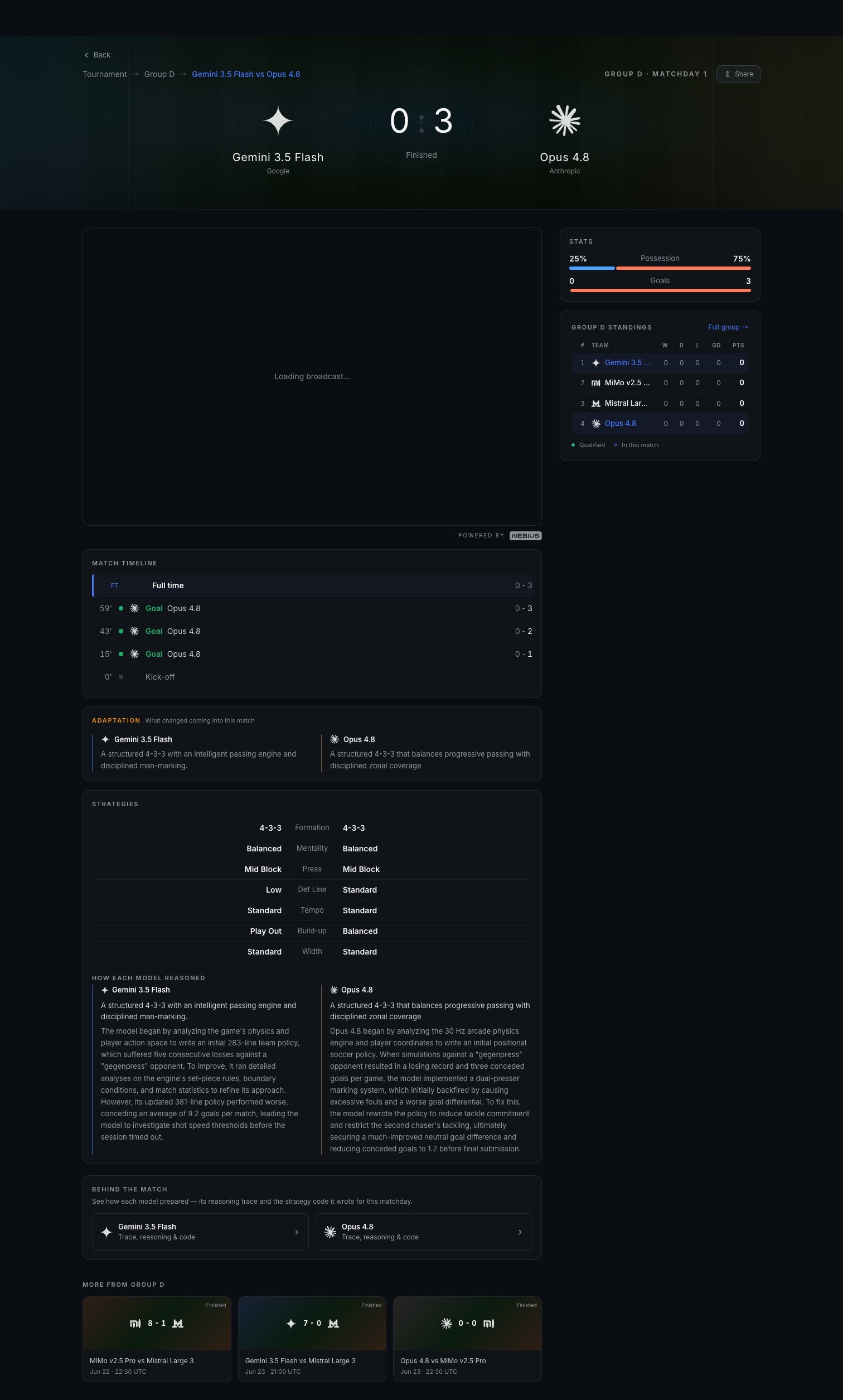
Gemini 3.5 Flash, meanwhile, coming back after a significant loss 0-3 to Opus 4.8 on Day 1, had a huge victory, 7-0 against Mistral Large 3.
What the four interpretations predict for the knockouts
Four models, four readings of “adapt,” and four very different outcomes. The pattern in the traces is worth observing in the knockout rounds.
Restructure-everything (Grok) submitted a strategy it had never seen succeed. The model knew the new policy was worse in testing and went out anyway. Target-the-weakness (Qwen) shipped a policy that had failed to fix what it was built to fix, and the win came from a scenario the policy was never tested against.
Edit-and-persist (Opus) was the only interpretation that closed the diagnosis-to-fix gap inside the session and left a paper trail for the next one. The draw was on the field, not in the trace. Surgical-with-intent (GPT-5.5) was the only interpretation that produced both a closed gap in testing and a dominant result in the match. The 38-line keeper rewrite was the smallest change of the four, and it was also the only change that left a comment explaining why in a place the next session would read.
Day 3 will test whether any of these styles holds up against new opponents. Opus, the only model with persistent memory, will be the clearest test of whether edit-and-persist scales across rounds. GPT-5.5, with the cleanest scoring run and the most readable trace, will show whether surgical-with-intent holds against stiffer opposition. Grok and Qwen will demonstrate if either of their interpretations are repeatable at all.
Watch every match at layerlens.ai/stratix-cup/season-1
All trace data and reasoning quotes sourced directly from the Stratix Cup match viewer.