
Eval Fatigue Is a Process Problem
Author:
The LayerLens Team
Last updated:
Published:
TL;DR
Eval fatigue is the most frequently reported pain point in 85 practitioner community threads (Reddit, HN, GitHub) from April-June 2026
Two distinct problems collapse into one manual workflow: calibration ("is my judge accurate?") and coverage ("am I testing the right things?")
Calibration is a setup problem. You run it once per judge, not once per release. GEPA calibration requires 30+ labeled examples.
Coverage is an ongoing problem. It expands from production traffic, not from pre-release scrambles.
Teams that run evals as continuous infrastructure stop talking about "running evals before a release." They talk about failure rate trends.
McKinsey's 2026 State of Organizations report found 88% of organizations use AI in at least one function. Fewer than one in four have successfully scaled it. Grant Thornton's 2026 AI Impact Survey found 78% of business executives lack confidence they could pass an independent AI governance audit within 90 days. The industry is deploying faster than it is evaluating.
Practitioners feel this directly. Across 85 threads on Reddit, HN, and GitHub from April-June 2026, eval fatigue was the pattern that appeared most consistently. Engineers described the same sequence: start with manual evals, fall behind model update cadence, abandon the eval process under ship pressure, regret it in production.
The fatigue has a structural cause.
The Two Problems That Get Collapsed
Eval fatigue almost always comes from collapsing two distinct problems into one manual pre-release workflow.
Calibration is the question of whether your judge is accurate. Does the LLM-as-judge you built actually correlate with human judgment on your specific outputs? This is a setup problem. You solve it once per judge version. GEPA calibration in Stratix requires 30+ labeled examples, pairs of outputs with human judgments, and produces a calibrated judge that holds its accuracy until the task definition changes. [Verify with engineering before publish]
Coverage is the question of whether you are testing the right things. Are your eval inputs representative of production traffic? Do your test cases cover the edge cases your users actually hit? Coverage needs to grow continuously. It cannot be solved in a single pre-release push.
When calibration and coverage live in the same manual process, every eval run re-validates the judge (whether it needs it or not) and leaves no time to expand coverage. Every release compounds the exhaustion.
What "Ship Fast" Pressure Actually Compresses
The pressure to ship quickly and demonstrate AI value does not make the eval tradeoff clearer. It makes it feel binary: delay the release to run evals, or skip evals to hit the deadline.
That framing assumes evals are a pre-release gate. They don't have to be.
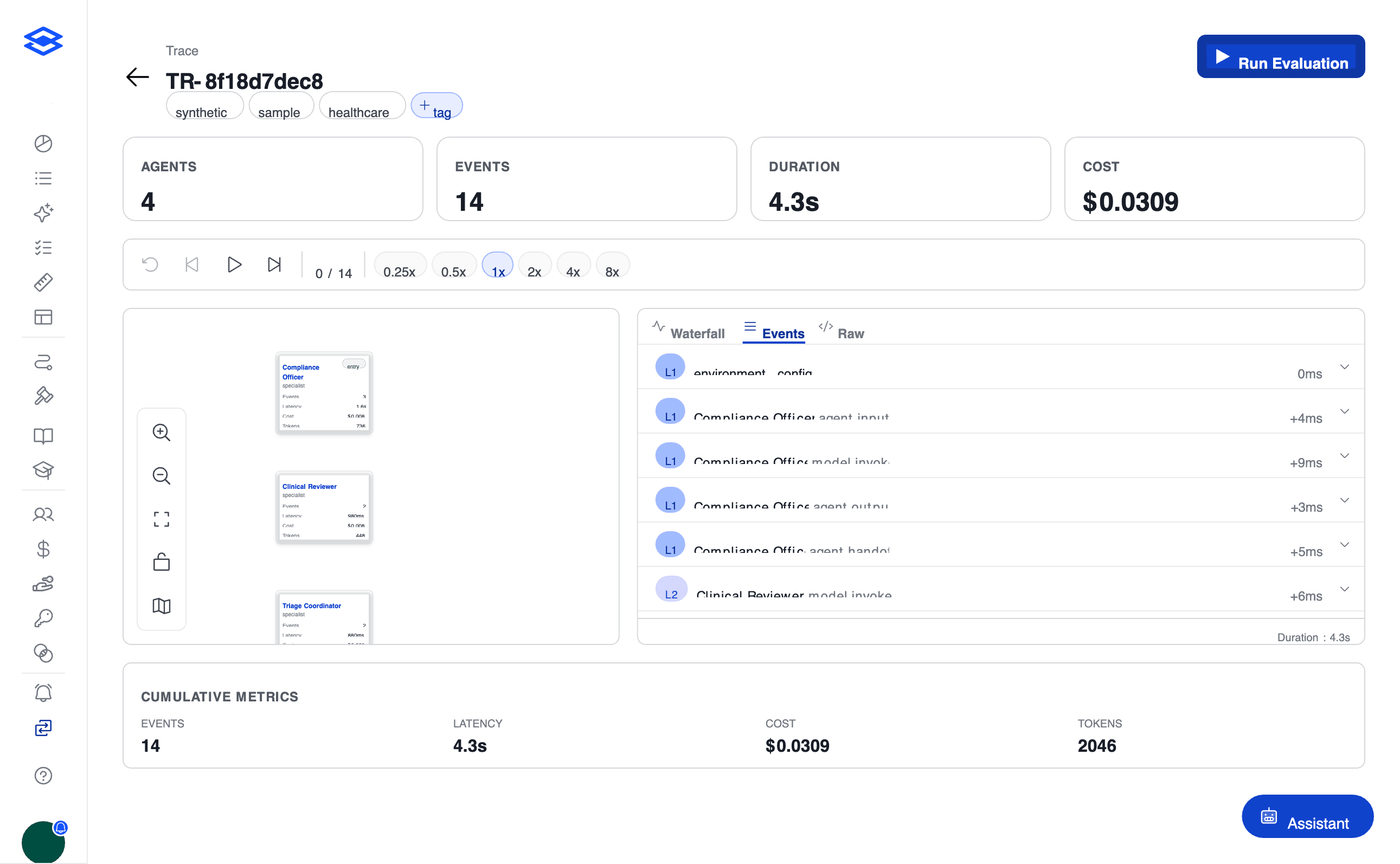
Continuous evaluation means the judge runs on a sample of production traffic every day, independent of release cycles. There is no gate to clear before shipping because the eval already fired on yesterday's data. The question shifts: not "did we pass before we shipped?" but "is the failure rate trending in the right direction this week?"
Teams that work this way stop tracking whether evals ran before a release. They track whether the failure rate trend is stable. The ship-pressure vs. eval-pressure tradeoff disappears because the eval process runs itself.
The Setup Cost Math
The objection is always: setting this up takes time upfront. That is true.
The question is what you compare it to. A manual eval process that a practitioner spends significant time on per release, run repeatedly across a high model update cadence, accumulates costs that continuous eval setup does not. The setup investment amortizes quickly. [Verify with engineering before publish]
The teams most burned out on evals are usually the ones who never front-loaded the setup, not the ones who did.
What Changes When Calibration and Coverage Are Separated
The eval system that does not create fatigue has three properties:
Judges are calibrated once and stable. A custom judge for "does this response meet our quality bar?" has a validated accuracy score against labeled examples. It does not need re-validation before every deployment run. It needs re-validation when the task definition changes.
Coverage expands from production data. New failure patterns from traces get added to the eval set on a regular cadence, weekly, not per-release. The eval set grows without a scramble.
Results are trends, not gates. The team reads "failure rate on the summarization judge was 12% last week, 8% this week," a stable signal that runs without intervention. A spike in failure rate triggers investigation. A stable decline is a green light.
None of this requires abandoning speed. It requires front-loading the setup so the recurring cost disappears.
Frequently Asked Questions
Why does eval fatigue happen even with good tooling?
Usually because the eval system is used as a release gate rather than a continuous signal. Even a well-designed eval system becomes exhausting if it demands manual runs before every deployment. The tooling question is secondary to the process question.
What's the minimum viable setup for continuous evaluation?
One calibrated judge per major task type (code generation, summarization, tool calling), running on a daily sample of production traces. Full coverage on day one is not required. A signal that runs without intervention is.
How do you know when a judge needs recalibration?
When the task it is evaluating changes in a way that the original labeled examples no longer cover. Model updates alone do not require recalibration unless the output format or task definition shifts.
Is eval fatigue a large-team problem or does it hit small teams harder?
Small teams and solo engineers feel it most acutely, because there is no buffer. When the engineer building the feature is also running the evals, evals are the first thing cut when the sprint gets tight.